
Going through restructuring?
Get your team’s performance
back on track!
Organizational changes reshape how people work together.
We help newly formed, merged and reorganized teams rebuild alignment,
set up improved ways of working and move forward with shared ownership.
Roles or responsibilities have changed
Two (or more) teams/functions have been merged
New leadership has changed expectations, priorities, or ways of working
Team members are not clear about how to make decisions or who owns the results
Trust and/or engagement has declined following the organizational changes
Previously effective ways of working no longer fit the new structure
People protect their own functions instead of collaborating across the new team(s)
The team must continue delivering results while still adapting to changes
Teams are now more globally distributed and working across cultures and time zones
Why do teams struggle with reorganizations and restructuring?
A new org chart doesn’t automatically create a functioning team.
When structures change, teams have to deliver results before they agree on how to work together.
Just because people are now a team on paper doesn’t mean that they:
share the same understanding of new priorities
know who owns which responsibilities
understand how to make new decisions
trust new colleagues or leaders
have stopped operating according to their old structure
feel a strong collective ownership for their goals
Understand how organizational changes are shaping your team
with the evidence-based
IMPACT Team Diagnostic ©
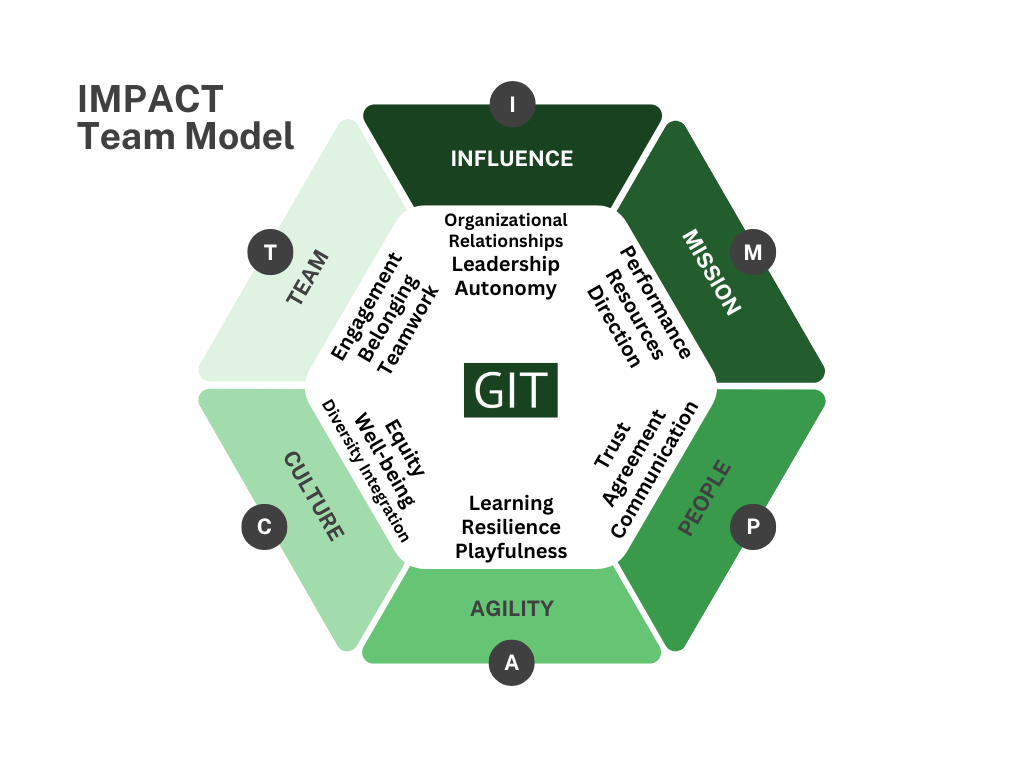
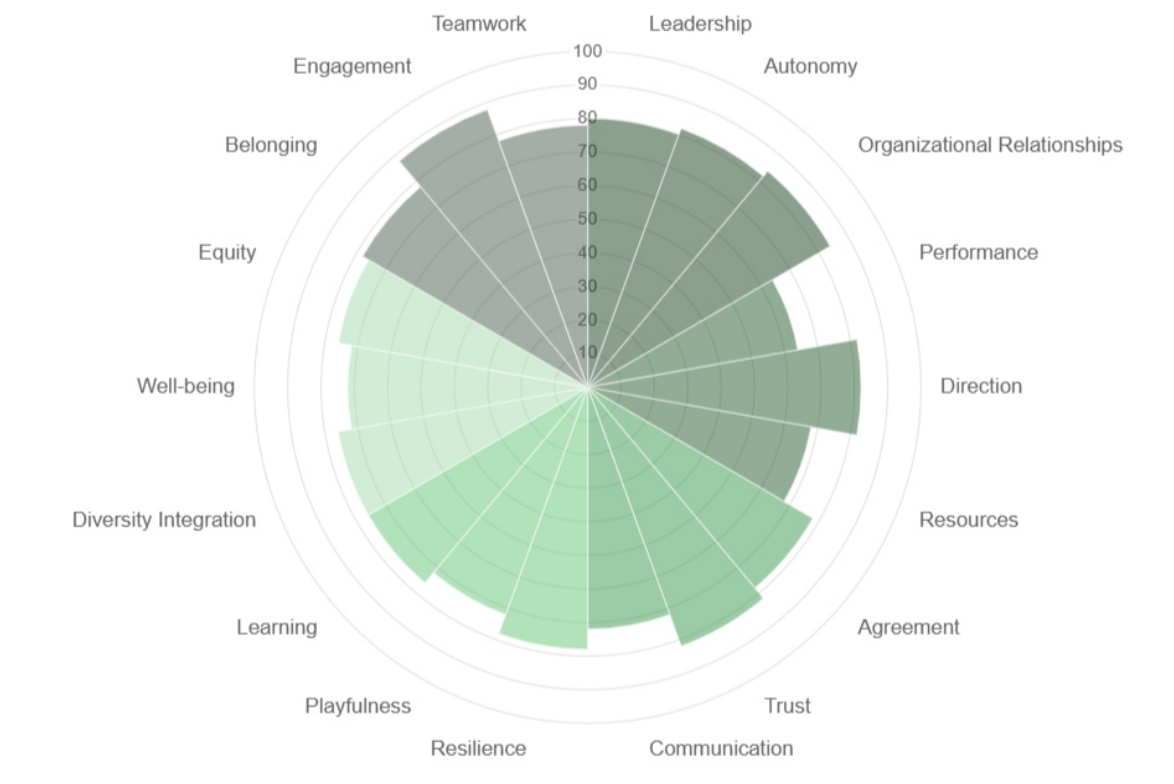
The IMPACT Team Diagnostic ©
shows a snapshot of the team’s behaviors based on
the dimensions of the
IMPACT Team Model ©
What can the IMPACT Team Diagnostic ©
reveal after restructuring?
Does the reorganized team understand its new place and influence within the organization?
The INFLUENCE Dimension might reveal:
Stakeholder confusion
Changed dependencies
Unclear external influence
Is the team aligned around its new mandate, priorities and measures of success?
The MISSION Dimension might reveal:
Conflicting priorities
Different interpretations of the team's new purpose
Are different legacy cultures, functions or locations integrating effectively?
The CULTURE Dimension might reveal:
Legacy practices
Resistance
Insufficient adaptation.
How have membership, leadership or reporting changes affected trust and relationships?
The PEOPLE Dimension might reveal:
Relationship strain
Reduced trust
Weak integration of new members
Is the new team developing shared ownership or still operating as separate groups?
The TEAM Dimension might reveal:
Existing silos
Weak collective accountability
Fragmented collaboration.
Can the team adapt its ways of working rather than reverting to old structures and habits?
The AGILITY Dimension might reveal:
Legacy practices
Resistance
Insufficient adaptation.
When to bring in the IMPACT Team Diagnostic Assessment
Change management helps the organization implement and navigate the change. Our focus is what happens inside teams as they adjust to that change. GIT helps organizations understand and strengthen that team-level transition. It complements organizational redesign and change-management work by focusing on the part that determines whether the new structure actually works in practice: how teams function within it.
Before restructuring
Before the changes happen, we help leaders understand what they are working with.
Whether the restructure is something you are driving yourself or a decision coming from the wider organization, it helps to know where your team is strong, where it is already under pressure, and what could be disrupted by the change.
How clear are people about where they are going?
How well do they work together?
Where are decisions already getting stuck?
How much do they depend on other teams to get things done?
This gives you a clearer picture of what needs attention before the structure changes. It can also highlight things that may be easy to overlook in the planning process, for example, a team that is performing well but is heavily dependent on relationships with another department, or a team that already has limited capacity and is about to take on more responsibility.
During restructuring
Once the restructuring is underway, we help leaders keep their teams collaborating effectively while people are dealing with uncertainty and change.
Priorities may be moving, responsibilities may be unclear, relationships between teams may be changing, and people may not yet know how decisions are supposed to get made. Meanwhile, the work still needs to get done.
We help leaders see where the team is starting to struggle and what needs to be addressed. Maybe people are no longer clear about what matters most. Decisions that used to take a day now take a week. Two teams that are expected to work together are still operating as separate groups. The focus is on helping the team adapt its way of working without losing the ability to deliver.
Immediately after restructuring
Once the new structure is in place, we help newly formed or redesigned teams make the new setup work in practice.
A new reporting line does not automatically create clarity. A merged team may still think and operate as two separate teams. People may have new responsibilities but still be unclear about who owns what, who makes which decisions, or how they are supposed to work with each other.
We help teams work through those practical questions:
How aligned are we on what we are here to achieve?
Who owns what?
How do we make decisions?
How do we handle disagreements?
What do we need from each other and from the rest of the organization?
The aim is to turn the new structure into a way of working that actually supports performance.
Three to Six Months After Restructuring
A few months later, we help leaders step back and ask:
Is the new structure actually working in the day-to-day reality of the team?
Are teams collaborating across the new boundaries?
Are the same problems coming back, despite the new structure?
This gives leaders a chance to identify the issues that have persisted after the initial transition. Perhaps the team still lacks clarity, trust or agreement. Sometimes, relationships with other parts of the organization remain difficult. People may adapt well in some areas but struggle with autonomy, resources or workload. The point is to identify what is still getting in the way and address it before it becomes the new normal.
Grounded in research and informed by 20+ years of practice, responsive to complexity, culture, and change,
IMPACT Team Diagnostic ©
is a psychometrically validated tool that leverages the potential of a team’s diverse backgrounds, skills and perspectives
to develop resilience, foster agility,
create ownership and become a more efficient and engaged team
through ongoing changes.

Used by leaders and teams in Banking, IT, Manufacturing, Healthcare, Education, Retail, Banking and other industries.
The IMPACT Team Diagnostic © helps you uncover:
Where expectations and priorities are misaligned
How ready or how resistant teams are to the new ways of working
How teams can be more open-minded towards change
Whether the new team can take responsibility and ownership for achieving shared goals
Where trust or relationships have been damaged
How stakeholder relationships have changed with the new structure
Which team behaviors require immediate attention
“More engaged teams are 18% more productive (in sales) and 23% more profitable.”
— Gallup, 2024
What does this actually help us do?
When a team has been reorganized, leaders need to know whether their people can actually get the work done, stay positive and collaborate effectively now that the structure has changed. The diagnostic assessment helps leaders spot team-level issues early before they show up as missed deadlines, slow decisions, recurring conflict, disengagement or declining performance.
GIT helps teams turn the new structure into practical ways of working. We help them:
Get clear on what matters most now, what success looks like, and where the team needs to focus its energy.
Agree on how they are going to work together when the old ways of working no longer fit.
Stop wasting time figuring out who should make which decision, who owns what, or who needs to be involved.
Bring tensions and frustrations into the open before they turn into ongoing conflict, avoidance or passive resistance.
Help people who are new to the team become part of the team, rather than leaving them to figure it out on their own.
Make accountability clear so things don't fall through the cracks between old and new responsibilities.
Rebuild trust when the restructure has disrupted relationships, created uncertainty or left people feeling unsettled.
Make collaboration across functions work when teams now have different responsibilities, priorities or reporting lines.
Replace “this is how we've always done it” with working practices that actually fit the new organization.
Why Focus on Teams?
Beyond individual leadership
Traditionally, organizations focus on individuals to drive high performance, but research shows that teamwork leads to improved performance, productivity and quality of decision-making.
In a complex global environment, developing individual human capital is not enough.
Team as a unit
Teams are the core of organizational performance and need dedicated support to align on goals, come together to anticipate challenges, collaborate under stress, and communicate proactively.
Collective lasting change
Individual change often remains with the person, while team change drives more impact.
Teams grow by sharing their experiences, reviewing their insights, establishing open communication practices, and creating a united, productive and engaged team climate.
What the IMPACT Team Diagnostic © measures and
why it matters
This is a “team first” diagnostic assessment that serves as a mirror for your team and focuses on collective performance and processes, not individuals.
The IMPACT Team diagnostic assessment doesn't just ask whether a team works well together. It examines the conditions that shape how the team works, how it connects to the organization, how people experience the team, and how capable the team is of adapting and delivering results.
Effective teams are no longer defined only by traditional factors such as trust, communication, goals and accountability. Modern teams operate in environments characterized by greater diversity, distributed work, rapid change, interdependence and ambiguity.
The model is built on a meta-analysis of 347 teams and 2,000+ participants, uncovering the real dynamics behind performance, accountability, and connection.
The IMPACT Team Diagnostic © measures 18 characteristics across six core dimensions of team life:
Influence
Mission
People
Agility
Culture
Team Orientation
Such granularity makes it possible to see important patterns and reveal the tensions behind team performance. These distinctions give leaders and coaches a much clearer starting point for intervention.
What makes it unique:
It is designed from the outset for the realities of global, hybrid and culturally diverse teams, while still being applicable to traditional co-located teams.
It reflects the realities of how teams work today. It looks beyond traditional team dynamics to the conditions that enable diverse, distributed and rapidly changing teams to perform.
It assesses the collective team functioning rather than the personality composition of the people within it.
It measures both the social-emotional environment and operational functioning (“hard” and “soft” team factors).
It examines the team's relationship with the wider organization, not just what happens inside the team.
It distinguishes the leader's perception of the team from the team's own perception.
It is built by experienced organizational coaches, backed by science and successfully used with teams of various sizes across multiple sectors.
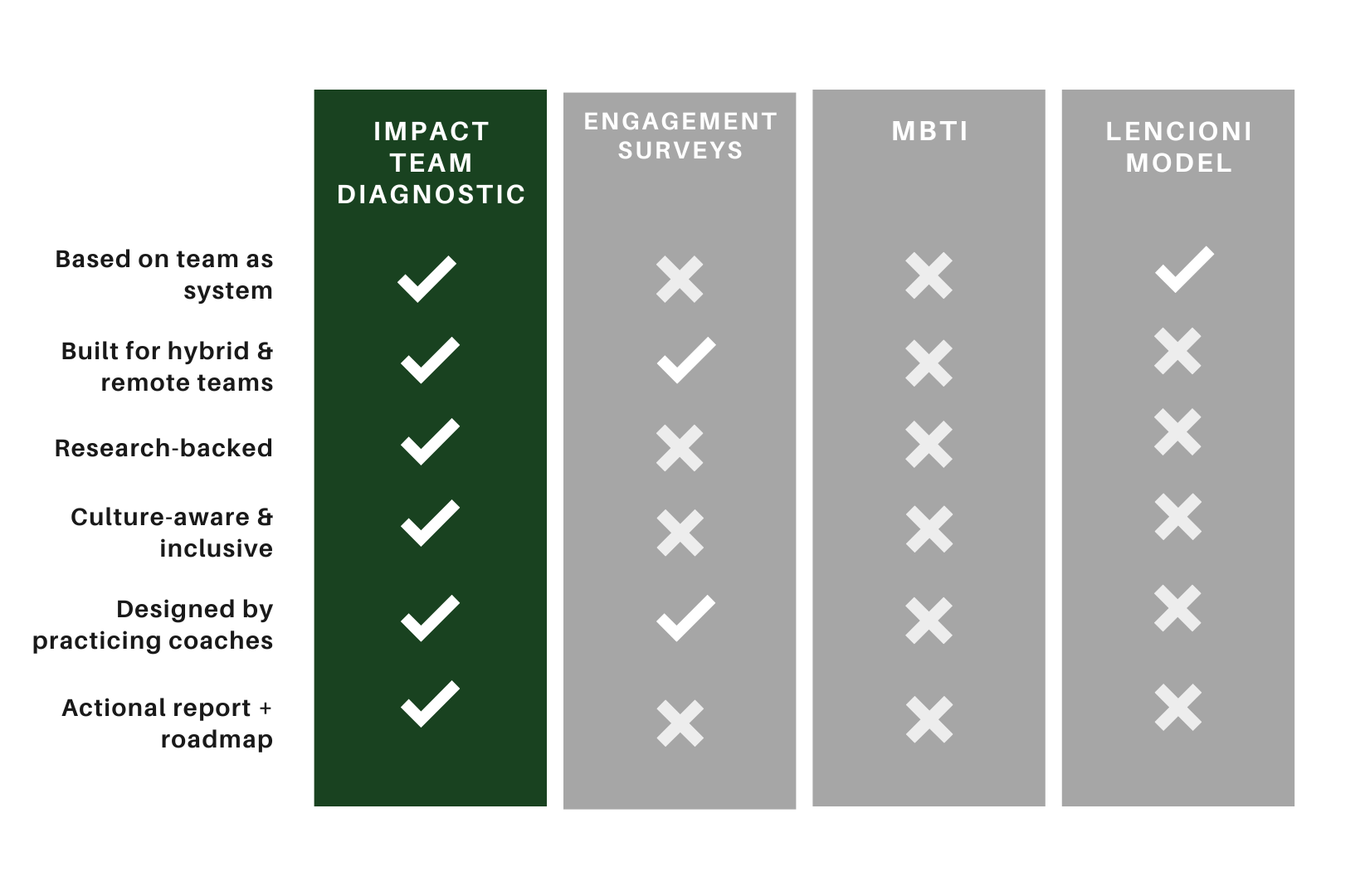
Why the IMPACT Team Diagnostic © is different:

Are you a Coach or Consultant interested to use the IMPACT Team Diagnostic © with your clients?
FAQ
-
There isn't one right moment. It can be useful before the restructure to understand what is already working and where the team may be vulnerable, during the transition to see where the change is creating friction, and again three to six months later to check whether the new structure is actually working at team level. The diagnostic gives you a team-level picture of what is happening, so you can focus your intervention on the issues that are most likely to affect performance.
-
Yes. We are not trying to replace the people already managing the organizational change. We can work alongside HR, OD, transformation or change-management teams and focus specifically on the team dynamics that affect whether the new structure works in practice.
This can also give internal teams useful information about where teams are struggling, without asking HR or the change team to personally facilitate every difficult team conversation.
-
Yes. In fact, that can be one of the most useful times to work with a team. People may have new responsibilities, new managers or new colleagues, but haven't yet worked out how to operate together. We can help the team establish clarity around priorities, ownership, decision-making and ways of working before old habits simply carry over into the new structure.
-
Yes. We work with leadership teams as well as functional, cross-functional and newly formed teams. Leadership teams are particularly important during restructuring because they are often responsible for translating organizational decisions into something their teams can actually execute.
We can work with the leadership team on issues such as shared direction, decision-making, accountability, organizational relationships and alignment, and then support the wider teams in turning those decisions into day-to-day ways of working.
-
Yes. This is particularly relevant when restructuring crosses countries, functions or cultures. What looks like a straightforward structural change from headquarters can have very different implications for teams in different markets. Expectations around leadership, decision-making, communication, hierarchy, ownership and disagreement can vary significantly.
Our experience working with multinational and cross-cultural organizations allows us to work with those differences. The aim is to help globally distributed teams develop ways of working that are clear enough to support consistent execution while still working across different cultural and organizational contexts.
-
Yes. This is one of its most useful applications. The diagnostic looks at the team as a collective (not at individual employees) across 18 aspects of team work.
Used after the restructure, it can help answer the question: Is this team actually functioning effectively in the new structure, and what is still getting in the way?
-
That's normal, and it doesn't need to be resolved before the work starts. People don't have to be happy about a restructuring for a team to work effectively within it. We help teams have productive conversations about what has changed, what remains unclear, what is getting in the way of their work and what they need from one another. The focus is not on persuading people to like the change; it is on helping the team function well despite the uncertainty.
-
Absolutely. The diagnostic isn't only for teams going through change.
It can be used whenever you want to understand how a team is functioning and where it could perform better. For example, you might use it with a leadership team that is struggling to make decisions, a high-performing team that wants to move to the next level, a newly appointed leader taking over an existing team, or a cross-functional team where collaboration has become difficult.
It can also be useful during leadership transitions, team development, strategic shifts, performance improvement initiatives, post-merger integration, global team development, or simply as a regular team health check. The question then is “How well are we functioning as a team, and what would make us more effective?”
-
Change management is typically concerned with helping the organization implement and adopt the change (communication, stakeholder engagement, transition planning, new processes and so on). Team coaching focuses on what happens when people actually have to work together inside the new structure.
For example, the organization may announce that two functions are now one team. Change management helps people understand the change. Team coaching helps the new team work out how they will make decisions, resolve disagreements, share ownership, communicate and collaborate when the old ways of working no longer fit.
-
We look for changes in how the team functions, not just whether people say they enjoyed the coaching. Depending on the situation, that might mean clearer priorities, faster or more effective decision-making, stronger ownership, better collaboration across functions, fewer recurring tensions, or a team becoming more capable of handling issues without everything escalating to the leader.
The IMPACT Team Diagnostic gives you a way to establish a baseline and then measure where the team has moved. This makes the conversation about results and ROI much more concrete: What was getting in the way before, what has changed, and what still needs attention?
-
Yes, this is one of the best practices. Repeating the diagnostic after an intervention gives you a way to see whether the team’s collective experience has actually shifted. It can be particularly useful after a restructuring, leadership change, team merger or major transformation, when you want to know whether improvements have lasted beyond the initial intervention.
It also helps avoid relying entirely on subjective interpretation. You can compare the team's current picture with the baseline and identify where meaningful movement has happened.
-
The return is ultimately about whether the team is functioning better in ways that matter to the business. If a leadership team spends less time revisiting the same decisions, a newly merged team stops duplicating work, cross-functional teams resolve issues faster, or managers no longer have to step into problems that the team can handle itself, there is a tangible organizational benefit.
The diagnostic helps identify the areas most connected to performance and gives you a way to track progress over time. We don't assume that every improvement can or should be reduced to a single financial number. Instead, we connect the work to the operational outcomes that matter in your particular context.
-
Most tools are designed for individuals, while the IMPACT Team Diagnostic © is team-centered, research-backed, and built for global complexity.
Engagement surveys measure employee satisfaction, not team dynamics. The IMPACT Team Diagnostic © shows how the team functions together and shows the earliest, most actionable signal of execution risk.Instead of planning a generic team intervention, The IMPACT Team Diagnostic © helps leaders see clearly which levers (clarity, collaboration, learning, accountability) might need to be adjusted for this team, at this moment."
-
The diagnostic takes around 20 minutes to complete (per participant). The clarity it provides to the entire team (when taking into account all team member’s perspectives) saves months of wasted meetings and misalignment.
-
Great! The IMPACT Team Diagnostic © will show where that work is paying off and what can be done to build on that to get even better results.
-
The real value does not come from a tool itself, but from how it is used. After completing the IMPACT Team diagnostic, your team receives not only a detailed report but also a debrief session. During this session, your coach, consultant, or facilitator will help turn the data into practical guidelines your team can apply every day. The real benefit is not in the general recommendations within the report, but in facilitating a live conversation that is for your team and about your team. Together, you’ll unpack your team dynamics using real examples, and identify concrete changes you can integrate into your team work. This approach makes the diagnostic a long-term instrument. It will also reveal whether there are patterns in your team dynamics that might prevent lasting change and help you address them.
-
Great teams always want to be better. The IMPACT Team Diagnostic © will show you how to go from strong to exceptional.
Download a sample
IMPACT Team Diagnostic ©
Report
Contact Us
Interested in working together?
Fill out some info and we will be in touch shortly. We can’t wait to hear from you!